
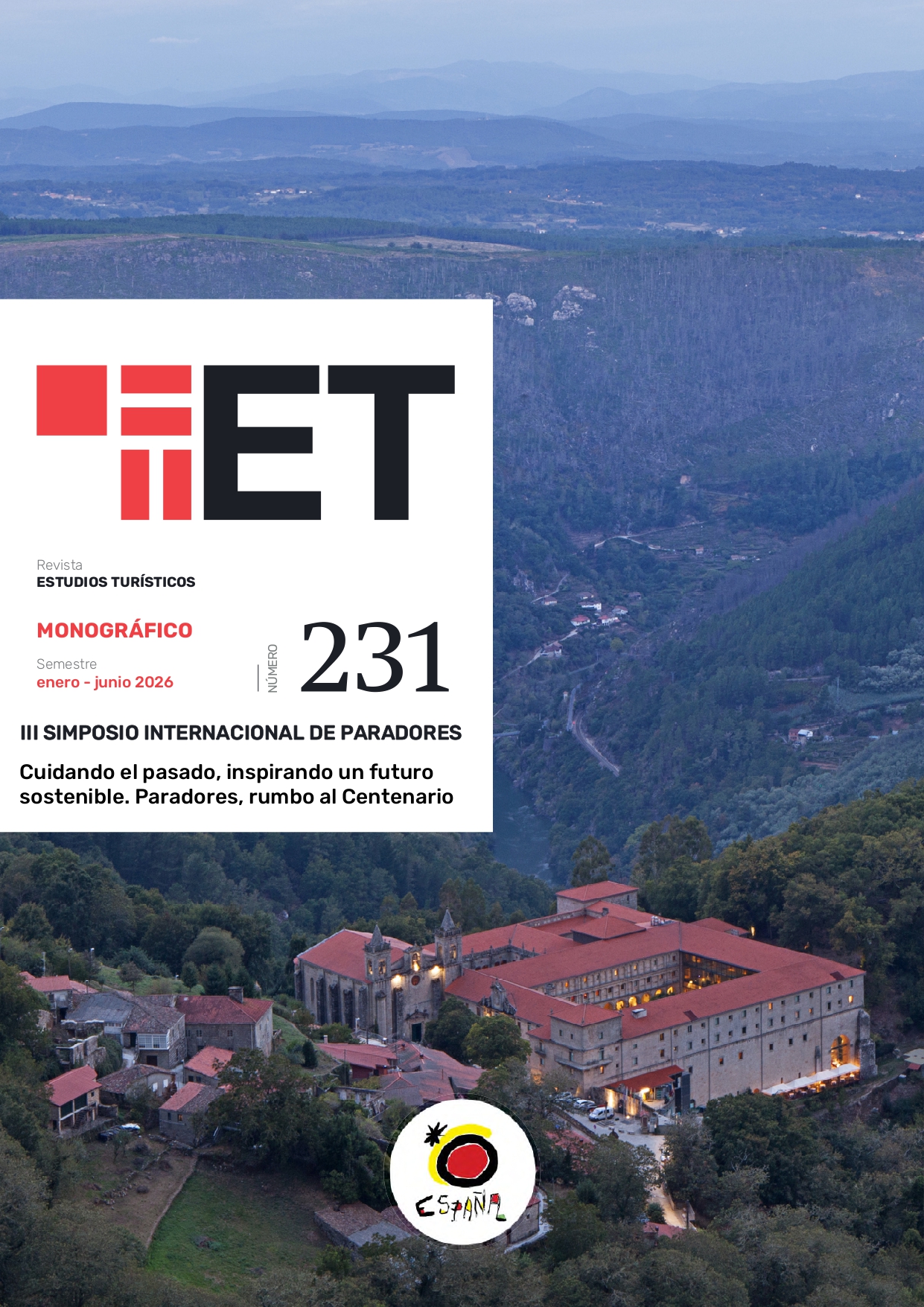
Opportunities in tourism ecology. The Paradores Network as a case study of tele-coupling between the countryside and the city.
Article Sidebar

This work is licensed under a Creative Commons Attribution-NonCommercial-ShareAlike 4.0 International License.
Main Article Content
This article applies complex systems science to examine the role of the Spanish National Network of Paradores as a potential agent of transition towards regenerative tourism. Using the conceptual framework of Coupled Human and Natural Systems (CHANS) and the adaptive cycle, the study analyses the impacts of this public hotel network on rural and natural territories. The analysis reveals that certain features of the Paradores’ tourism offer help to promote territorial stewardship and community resilience. However, under other circumstances, they may contribute to processes of disarticulation within the territorial systems in which they are embedded. Considering the public nature of Paradores and its mission as a benchmark institution in tourism culture, the article argues for the need to strengthen its agency through three main lines of action: fostering conscious tourism, promoting practices that contribute to local governance, and driving the transformation of infrastructure and travel-related mobility systems in order to minimise energy consumption and cultural and ecological impacts. The article concludes that Paradores has significant potential to play a relevant role in the transition towards more conscious and regenerative tourism models in rural and natural environments.
Article Details
Abson, D. J., Fischer, J., Leventon, J., Newig, J., Schomerus, T., Vilsmaier, U., von Wehrden, H., Abernethy, P., Ives, C. D., Jager, N. W., & Lang, D. J. (2017). Leverage points for sustainability transformation. Ambio, 46(1), 30–39. https://doi.org/10.1007/s13280-016-0800-y DOI: https://doi.org/10.1007/s13280-016-0800-y
Barke, M. (2004). Rural tourism in Spain. International Journal of Tourism Research, 6(3), 137–149. https://doi.org/10.1002/jtr.480 DOI: https://doi.org/10.1002/jtr.480
Cox, D. T. C., Hudson, H. L., Shanahan, D. F., Fuller, R. A., & Gaston, K. J. (2017). The rarity of direct experiences of nature in an urban population. Landscape and Urban Planning, 160, 79–84. https://doi.org/10.1016/j.landurbplan.2016.12.006 DOI: https://doi.org/10.1016/j.landurbplan.2016.12.006
Crabolu, G., Font, X., & Eker, S. (2023). Evaluating policy complexity with Causal Loop Diagrams. Annals of Tourism Research, 100, 103572. https://doi.org/10.1016/j.annals.2023.103572 DOI: https://doi.org/10.31235/osf.io/2c83b
Crous-Costa, N., Real, J., Rodríguez-Martín, S., & Martín, V. O. M. (2025). ¿Cómo pueden los anfitriones recobrar la capacidad de decidir sobre su hogar? Perspectivas desde el caso de las Islas Canarias. Estudios Turísticos, (229). https://doi.org/10.61520/et.2292025.1250
Cupeiro, P. (2019). Viajar a través del tiempo: El reto cultural de Paradores. Estudios Turísticos, (217–218), 117–132. https://doi.org/10.61520/et.217-2182019.71
Cupeiro, P. (2022). Paradores y sus señas identitarias. El arte de la travesía, la cultura del territorio. Estudios Turísticos, (224), 133–156. https://doi.org/10.61520/et.2242022.19 DOI: https://doi.org/10.61520/et.2242022.19
De Lucio, J. V. (2006). Las áreas naturales protegidas, un éxito inconcluso. En J. Araújo, L. Balairón Ruiz, M. Delibes de Castro, C. M. Duarte, J. Fernández, J. Lamo de Espinosa, J. V. de Lucio, J. C. del Olmo, F. I. Pugnaire, X. Querol, & O. Rodríguez de la Fuente, B. Varillas, Félix, 25 años de conciencia ecológica. Fundación BBVA.
De Lucio, J. V., Montes, D., & Seijo, F. (2025). Utilitarian and non-utilitarian value orientations animate consumer and producer participation in agroecological initiatives. Agroecology and Sustainable Food Systems, 1–26. https://doi.org/10.1080/21683565.2025.2575013
De Lucio, J. V., & Múgica, M. (1994). Landscape preferences and behaviour of visitors to Spanish national parks. Landscape and Urban Planning, 29(2–3), 145–160. https://doi.org/10.1016/0169-2046(94)90024-8 DOI: https://doi.org/10.1016/0169-2046(94)90024-8
De Lucio, J. V., & Seijo, F. (2021). Do biosphere reserves bolster community resilience in coupled human and natural systems? Evidence from 5 case studies in Spain. Sustainability Science, 16, 2123–2136. https://doi.org/10.1007/s11625-021-01029-3 DOI: https://doi.org/10.1007/s11625-021-01029-3
De Lucio, J. V., & Seijo, F. (2023). Agroecological transitions to sustainability and biosphere reserves. Agroecology and Sustainable Food Systems, 47(8), 1207–1236. https://doi.org/10.1080/21683565.2023.2231370 DOI: https://doi.org/10.1080/21683565.2023.2231370
Díaz, S., Demissew, S., Carabias, J., Joly, C., Lonsdale, M., Ash, N., Larigauderie, A., Adhikari, J. R., Arico, S., Báldi, A., Bartuska, A., Baste, I. A., Bilgin, A., Brondizio, E., Chan, K. M., Figueroa, V. E., Duraiappah, A., Fischer, M., Hill, R., Koetz, T., Leadley, P., Lyver, P., Mace, G. M., Martin-Lopez, B., Okumura, M., Diego Pacheco, Pascual, U., Pérez, E. S., Reyers, B., Roth, E., Saito, O., Scholes, R. J., Sharma, N., Tallis, H., Thaman, R., Watson, R., Yahara, T., Hamid, Z. A., Akosim, C., Al-Hafedh, Y., Allahverdiyev, R., Amankwah, E., Asah, S T., Asfaw, Z., Bartus, G., Brooks, L. A., Caillaux, J., Dalle, G., Darnaedi, D., Driver, A., Erpul, G., Escobar-Eyzaguirre, P., Failler, P., Fouda, A. M. M., Fu, B., Gundimeda, H., Hashimoto, S., Homer, F., Lavorel, S., Lichtenstein, G., Mala, W. A., Mandivenyi, W., Matczak, P., Mbizvo, C., Mehrdadi, M., Metzger, J. P., Mikissa, J. B., Moller, H., Mooney, H. A., Mumby, P., Nagendra, H., Nesshover, C., Oteng-Yeboah, A. A., Pataki, G., Roué, M., Rubis, J., Schultz, M., Smith, P., Sumaila, R., Takeuchi, K., Thomas, S., Verma, M., Yeo-Chang, Y., & Zlatanova, D. (2015). The IPBES Conceptual Framework—Connecting nature and people. Current Opinion in Environmental Sustainability, 14, 1–16. https://doi.org/10.1016/j.cosust.2014.11.002 DOI: https://doi.org/10.1016/j.cosust.2014.11.002
Europa Press. (2022, October 22). Reyes Maroto inaugura el parador de A Costa da Morte (Muxía), ‘símbolo de sostenibilidad y recuerdo del Prestige’. Europa Press. https://www.europapress.es/galicia/noticia-reyes-maroto-inaugura-parador-costa-da-morte-muxia-simbolo-sostenibilidad-recuerdo-prestige-20221022145956.html
Farstad, E., Mehmetoglu, M., Landa-Mata, I., Higham, J., Hopkins, D., & Steen Jacobsen, J. Kr. (2025). Recasting sustainable summer holidaying: Scripts, time experiences, freedom, place change and environmental imprints. Journal of Sustainable Tourism, 33(3), 395–415. https://doi.org/10.1080/09669582.2024.2346772 DOI: https://doi.org/10.1080/09669582.2024.2346772
Findlay, H. S., Feely, R. A., Jiang, L.-Q., Pelletier, G., & Bednaršek, N. (2025). Ocean Acidification: Another Planetary Boundary Crossed. Global Change Biology, 31(6), e70238. https://doi.org/10.1111/gcb.70238 DOI: https://doi.org/10.1111/gcb.70238
Folke, C., Carpenter, S., Elmqvist, T., Gunderson, L., Holling, C. S., & Walker, B. (2002). Resilience and sustainable development: Building adaptive capacity in a world of transformations. AMBIO: A Journal of the Human Environment, 31(5), 437–440. DOI: https://doi.org/10.1579/0044-7447-31.5.437
Fuster, M., Müller, N., Sard, M., & Salom, M. B. (2025). Sostenibilidad, gobernanza y turistificación. El impuesto de turismo sostenible de las Islas Baleares (ITS-IB). Estudios Turísticos, (229). https://doi.org/10.61520/et.2292025.1231
FVS. (2025). Ciudades que cuidan del campo. FVS. https://www.vidasostenible.org/proyectos/ciudades-que-cuidan-del-campo/
Gilmore, J. H., & Pine, J. (1998). Welcome to the experience economy. Harvard Business Review, 76(4), 97–105.
Gómez Gutiérrez, J. L. (2016). Francisco Giner de los Ríos, la Institución Libre de Enseñanza, y su labor como “descubridores” de la sierra del Guadarrama. Indivisa, Boletín de Estudios e Investigación, (16), 36. https://doi.org/10.37382/indivisa.vi16.241 DOI: https://doi.org/10.37382/indivisa.vi16.241
Gómez-Limón, F. J., & de Lucio, J. V. (1995). Recreational activities and loss of diversity in grasslands in Alta Manzanares Natural Park, Spain. Biological Conservation, 74(2), 99–105. https://doi.org/10.1016/0006-3207(95)00018-Y
Grant Thornton. (2024). Paradores de Turismo de España Cuentas anuales e informe de gestión del ejercicio 2023 (p. 139). https://paradores.es/sites/default/files/2024-07/CCAA-Paradores-de-Turismo-de-Espana-2023_0.pdf
Hernández, J. M., Suárez-Vega, R., & Santana-Jiménez, Y. (2016). The inter-relationship between rural and mass tourism: The case of Catalonia, Spain. Tourism Management, 54, 43–57. https://doi.org/10.1016/j.tourman.2015.10.015 DOI: https://doi.org/10.1016/j.tourman.2015.10.015
Hiernaux–Nicolas, D. (2002). Turismo e imaginarios. In D. Hiernaux–Nicolas, A. Cordero, & L. Van Duynen (Eds), Imaginarios sociales y turismo sostenible. Facultad Latinoamericana de Ciencias Sociales (Flacso).
Holling, C. S. (2001). Understanding the Complexity of Economic, Ecological, and Social Systems. Ecosystems, 4(5), 390–405. https://doi.org/10.1007/s10021-001-0101-5 DOI: https://doi.org/10.1007/s10021-001-0101-5
Hull, V., & Liu, J. (2018). Telecoupling: A new frontier for global sustainability. Ecology and Society, 23. https://doi.org/10.5751/ES-10494-230441 DOI: https://doi.org/10.5751/ES-10494-230441
Hussain, A., & Haley, M. (2022). Regenerative Tourism Model: Challenges of Adapting Concepts from Natural Science to Tourism Industry. Journal of Sustainability and Resilience:, 2(1 Article 4). https://digitalcommons.usf.edu/jsr/vol2/iss1/4
IFEMA. (2025). FITUR desborda sus previsiones en un año de cifras récord. https://www.ifema.es/fitur/noticias/balance-2025
IPBES. (2022). Summary for policymakers of the methodological assessment of the diverse values and valuation of nature of the Intergovernmental Science-Policy Platform on Biodiversity and Ecosystem Services (IPBES). En U. Pascual, P. Balvanera, M. Christie, B. Baptiste, D. González-Jiménez, C. B. Anderson, S. Athayde, D. N. Barton, R. Chaplin-Kramer, S. Jacobs, E. Kelemen, R. Kumar, E. Lazos, A. Martin, T. H. Mwampamba, B. Nakangu, P. O’Farrell, C. M. Raymond, S.M. Subramanian, M. Termansen, M. Van Noordwijk, & A. Vatn (eds.) (Version 1.1, p. 37). IPBES secretariat. https://doi.org/10.5281/ZENODO.6522392
Jiménez-Esquinas, G. (2017). “This is not only about culture”: On tourism, gender stereotypes and other affective fluxes. Journal of Sustainable Tourism, 25(3), 311–326. https://doi.org/10.1080/09669582.2016.1206109
Jiménez-Esquinas, G. (2020). ‘Outro Máis’: Capitalismo del desastre del Prestige. ARIES, Anuario de Antropología Iberoamericana, (2020). https://aries.aibr.org/articulo/2020/25/3443/outro-mais-capitalismo-del-desastre-del-prestige
Jurgens, S. S., Mijts, E., & Van Rompaey, A. (2024). Are there limits to growth of tourism on the Caribbean islands? Case-study Aruba. Frontiers in Sustainable Tourism, 3-. https://doi.org/10.3389/frsut.2024.1292383 DOI: https://doi.org/10.3389/frsut.2024.1292383
Klein, N. (2007). La doctrina del Shock: El auge del capitalismo del desastre. Paidos Ibérica.
Koles, B., Wells, V., & Tadajewski, M. (2018). Compensatory consumption and consumer compromises: A state-of-the-art review. Journal of Marketing Management, 34(1–2), 96–133. https://doi.org/10.1080/0267257X.2017.1373693
Korcz, N. (2025). Nature Deficit in the Context of Forests and Human Well-Being: A Systematic Review. Forests, 16(10), 1537. (3265899234). https://doi.org/10.3390/f16101537 DOI: https://doi.org/10.3390/f16101537
Kuo, F. E. “Ming”. (2013). Nature-deficit disorder: Evidence, dosage, and treatment. Journal of Policy Research in Tourism, Leisure and Events, 5(2), 172–186. https://doi.org/10.1080/19407963.2013.793520 DOI: https://doi.org/10.1080/19407963.2013.793520
Li, D., Zhai, Y., Chang, P.-J., Merrill, J., Browning, M. H. E. M., & Sullivan, W. C. (2022). Nature deficit and senses: Relationships among childhood nature exposure and adulthood sensory profiles, creativity, and nature relatedness. Landscape and Urban Planning, 226, 104489. https://doi.org/10.1016/j.landurbplan.2022.104489 DOI: https://doi.org/10.1016/j.landurbplan.2022.104489
Liddle, M. (1997). Recreation ecology: The ecological impact of outdoor recreation and ecotourism. Chapman & Hall Ltd.
Litvak, L. (2000). A la Playa. EL mar como tema de la modernidad en la pintura española, 1870-1936. In L. Litvak (Ed.), A la Playa. Catálogo (pp. 13–63). Fundación Cultural Mapfre Vida.
Liu, J. (2001). Ecological Degradation in Protected Areas: The Case of Wolong Nature Reserve for Giant Pandas. Science, 292(5514), 98–101. https://doi.org/10.1126/science.1058104 DOI: https://doi.org/10.1126/science.1058104
MacCannell, D. (1973). Staged Authenticity: Arrangements of Social Space in Tourist Settings. American Journal of Sociology, 79(3), 589–603. https://doi.org/10.1086/225585 DOI: https://doi.org/10.1086/225585
MacCannell, D. (2003). El turista. Una nueva teoría de la clase ociosa. Melusina.
Mancha-Cáceres, O., & Ramírez-García, S. (2025). Hacia una ruralidad regenerativa: Transformando el turismo en una oportunidad para la innovación comunitaria en clave de transición ecosocial. In O. Mancha-Cáceres & S. Ramírez-García (Eds), Ruralidades y Turismos: Miradas para la regeneración ecosocial de lo rural (pp. 23–44). La Catarata.
Mansilla, J. (2025). Marca Barcelona. Políticas turísticas y contra la turistificación. Estudios Turísticos, (229). https://doi.org/10.61520/et.2292025.1235 DOI: https://doi.org/10.61520/et.2292025.1235
Mayer, A., Martín-López, B., Locatelli, B., Rabeschini, G., Liu, J., Loos, J., Felipe-Lucia, M. R., Riechers, M., & Isaac, R. (2025). A metacoupling lens on the co-production of nature’s contributions to people: Insights for sustainability. , 72, 91–115. Elsevier. https://doi.org/10.1016/bs.aecr.2025.02.001 DOI: https://doi.org/10.1016/bs.aecr.2025.02.001
McDonald, J. R. (2009). Complexity science: An alternative world view for understanding sustainable tourism development. Journal of Sustainable Tourism, 17(4), 455–471. https://doi.org/10.1080/09669580802495709 DOI: https://doi.org/10.1080/09669580802495709
Meadows, D. (2002, March). Dancing with Systems. The Systems Thinker, 13(2). https://thesystemsthinker.com/dancing-with-systems/
Moya, A. M. (1984). El Viaje en la pedagogía de la Institución Libre de Enseñanza: (Reflexiones sobre la sentencia 125-84, de 20 de diciembre, del Tribunal Constitucional). Estudios Turísticos, (83), 85–99. https://doi.org/10.61520/et.831984.491
Múgica, M., & de Lucio, J. V. (1992). Tipología de los visitantes que acuden a los parques nacionales. Quercus, 78, 34–39.
ONU Turismo. (2021). Lanzamiento de la Declaración de Glasgow: Un compromiso para una década de acción climática en el turismo. https://www.untourism.int/es/event/lanzamiento-de-la-declaracion-de-glasgow-un-compromiso-para-una-decada-de-accion-climatica-en-el-turismo
ONU Turismo. (2025). UN Tourism Data Dashboard | Key Indicators. https://www.untourism.int/tourism-data/un-tourism-tourism-dashboard
Paradores de Turismo de España. (s. f.). Parador Costa da morte. https://paradores.es/es/parador-costa-da-morte
Paradores de Turismo de España. (s. f.). Parador de Molina de Aragón. https://paradores.es/es/parador-de-molina-de-aragonParadores de Turismo de España. (2025, febrero 19). III Simposio Internacional. Paradores abandera la conservación del patrimonio cultural y natural en pro de un turismo responsable. https://paradores.es/es/iii-simposio-internacional-paradores-abandera-la-conservacion-del-patrimonio-cultural-y-natural-en
Pollock, A. (2016, November 21). Approach. Conscious Travel. https://www.conscious.travel/approach/
Pollock, A. (2019). Flourishing Beyond Sustainability. The promise of a regenerative tourism. Proceedings of the ETC,Workshop. European Travel Commision. https://etc-corporate.org/uploads/2019/02/06022019_Anna_Pollock_ETCKrakow_Keynote.pdf
Ravetz, J. R. (2006). Post-Normal Science and the complexity of transitions towards sustainability. Ecological Complexity, 3, 275–284. DOI: https://doi.org/10.1016/j.ecocom.2007.02.001
Raya Rey, A. N., Pizarro, J. C., Anderson, C. B., & Huettmann, F. (2017). Even at the uttermost ends of the Earth: How seabirds telecouple the Beagle Channel with regional and global processes that affect environmental conservation and social-ecological sustainability. Ecology and Society, 22(4). https://doi.org/10.5751/ES-09771-220431 DOI: https://doi.org/10.5751/ES-09771-220431
Richardson, K., Steffen, W., Lucht, W., Bendtsen, J., Cornell, S. E., Donges, J. F., Drüke, M., Fetzer, I., Bala, G., Von Bloh, W., Feulner, G., Fiedler, S., Gerten, D., Gleeson, T., Hofmann, M., Huiskamp, W., Kummu, M., Mohan, C., Nogués-Bravo, D., Petri, S., Porkka, M., Rahmstorf, S., Schaphoff, S., Thonicke, K., Tobian, A., Virkki, V., Wang-Erlandsson, L., Weber, L., Rockström, J. (2023). Earth beyond six of nine planetary boundaries. Science Advances, 9(37), eadh2458. https://doi.org/10.1126/sciadv.adh2458 DOI: https://doi.org/10.1126/sciadv.adh2458
Robles, I. (2025, September 8). Molina de Aragón: El nuevo baluarte de Paradores. Paradores. https://paradores.es/es/blog/molina-de-aragon-el-nuevo-baluarte-de-paradores
Rodale, R. (1983). Breaking new ground-the search for a sustainable agriculture. Futurist, 17(1), 15–20.
Rodríguez-Rodríguez, D., Larrubia, R., & Sinoga, J. D. (2021). Are protected areas good for the human species? Effects of protected areas on rural depopulation in Spain. Science of The Total Environment, 763, 144399. https://doi.org/10.1016/j.scitotenv.2020.144399 DOI: https://doi.org/10.1016/j.scitotenv.2020.144399
Schreefel, L., Tittonell, P., Steenman, E., Adler, F., Buffara, R., Freundt, S., Groot, J., & Aguilar-Gallegos, N. (2025). Global and local knowledge networks spread regenerative agriculture in Europe. In Review. https://doi.org/10.21203/rs.3.rs-7519599/v1 DOI: https://doi.org/10.21203/rs.3.rs-7519599/v1
Servicio de Análisis y prospectiva del MAPA. (2021). Demografía de la población rural en 2020 (Catálogo de Publicaciones de La Administración General Del Estado: https://Cpage.Mpr.Gob.Es/ No. 31; Análisis y Prospectiva – Serie AgrInfo). Ministerio de Agricultura, Pesca y Alimentación. https://www.mapa.gob.es/es/ministerio/servicios/analisis-y-prospectiva/default.aspx
Soliguer-Guix, A. (2025). Perspectivas críticas de los residentes de Barcelona frente a la gobernanza turística. Estudios Turísticos, (229). https://doi.org/10.61520/et.2292025.1237 DOI: https://doi.org/10.61520/et.2292025.1237
Sun, Y.-Y., Faturay, F., Lenzen, M., Gössling, S., & Higham, J. (2024). Drivers of global tourism carbon emissions. Nature Communications, 15(1), 10384. https://doi.org/10.1038/s41467-024-54582-7 DOI: https://doi.org/10.1038/s41467-024-54582-7
Tabales, A. F., & Pavón, E. S. (2025). Dialécticas de acción/reacción ante el overtourism. Políticas públicas y movimientos ciudadanos en la ciudad de Sevilla. Estudios Turísticos, (229). https://doi.org/10.61520/et.2292025.1255
Tittonell, P. (2023). A Systems Approach to Agroecology. Springer Nature Switzerland. https://doi.org/10.1007/978-3-031-42939-2 DOI: https://doi.org/10.1007/978-3-031-42939-2
Tittonell, P., El Mujtar, V., Felix, G., Kebede, Y., Laborda, L., Luján Soto, R., & De Vente, J. (2022). Regenerative agriculture—Agroecology without politics? Frontiers in Sustainable Food Systems, 6, 844261. https://doi.org/10.3389/fsufs.2022.844261 DOI: https://doi.org/10.3389/fsufs.2022.844261
Vargas del Río, D. (2020). Ecología política, turismo y conservación (1st edn). ITESO. https://doi.org/10.2307/j.ctv11vcd22 DOI: https://doi.org/10.2307/j.ctv11vcd22
Veblen, T. (1899). The theory of the leisure class: An economic study in the evolution of institutions. Macmillan.
Wolf, I. D., Croft, D. B., & Green, R. J. (2019). Nature Conservation and Nature-Based Tourism: A Paradox? Environments, 6(9). https://doi.org/10.3390/environments6090104 DOI: https://doi.org/10.3390/environments6090104